What's the Difference Between Our Railroad Spike Knife and High Carbon Knife Workshops?
Updated: Sep 30
Both workshops end the same way: you walk out holding a knife you forged yourself. But the steel is different, the process is different, and the skill being asked of you is different. Here's what actually separates the two, so you can pick the right one instead of guessing.
What's identical between them is everything about the experience itself. It's hands-on the whole time, guided by an instructor at every step, working real steel with real tools. The difference isn't in how "premium" the experience feels. It's in the material you're handed and what that material is capable of once it leaves the shop.

The Railroad Spike Knife: Salvaged Steel, Built for a First Try
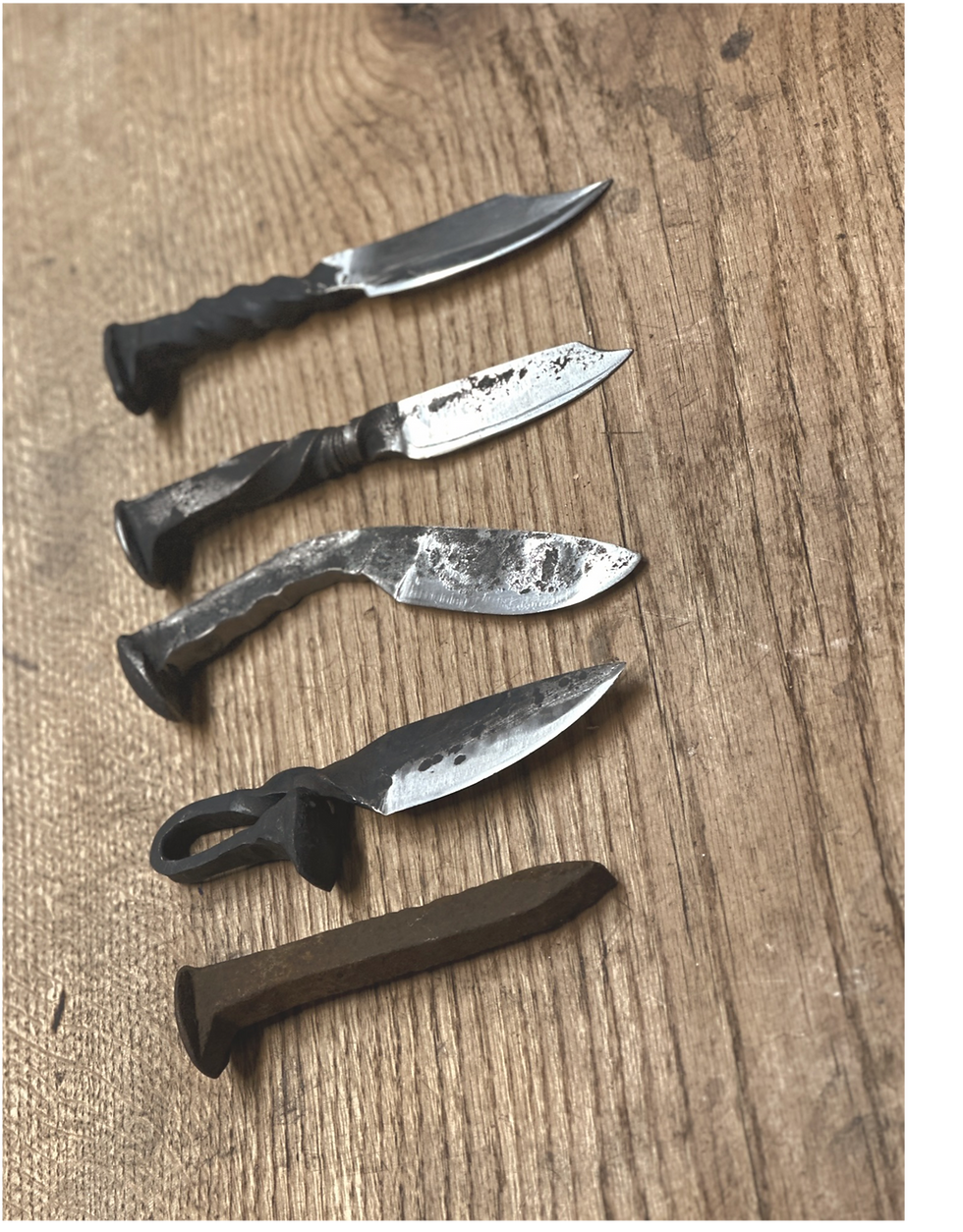
Every blade starts as a retired railroad spike, real steel that spent decades holding rail line together before it was pulled from service. It's mild-to-medium carbon steel by cutlery standards, which means it's forgiving to forge: a wide working temperature window, tolerant of a beginner's timing, and easy to bring back up to heat and correct if your first pass at the bevel isn't quite right.
Here's the part that surprises people: we don't heat-treat or quench the blades in this workshop. That's on purpose. Hardening is exactly where cracking and warping tend to creep in, and it's a genuinely hard thing to nail on your first afternoon at a forge. Skipping it here means the build stays forgiving from the first hammer strike to the last and nobody's two-hour project gets undone by a finicky quench at the very end. What you're really learning in this workshop is the foundation: reading steel by colour, controlling a hammer, drawing out a shape with intention.
Then there's grinding, refining the bevel on the 2x72 belt grinder takes a completely different kind of touch than hammer work, a feel for how much pressure and angle actually removes material evenly without overheating the edge or grinding away the geometry you just spent an hour forging. That's the whole point of this workshop: salvaged steel is the right material to learn both of those skills on.
The High Carbon Knife: Purchased Steel, Full Heat Treat
This workshop starts from a different place entirely. Instead of salvaged spikes, we use new, purchased high-carbon steel and because that steel can be hardened properly, this build includes a full heat treat: quenching and tempering the blade to get genuine hardness and edge retention, not just a shape that happens to be sharp.
That's a meaningfully different skill ask. High-carbon steel has a narrower window at the forge and it's less tolerant of overheating, and the quench has to be timed and executed with more precision, because this steel actually can crack or warp if that step goes wrong. It rewards someone who's already got a bit of hammer control and a feel for reading heat, which is exactly why we treat it as the next step up as an intermediate workshop rather than a starting point.
Why the Trade-off Exists
This isn't an arbitrary tiering — it's a straightforward metallurgy trade-off. Softer, more forgiving steel is easier to shape and harder to ruin, but it won't hold a working edge the way a properly hardened high-carbon blade will. Steel hard enough to hold a genuinely sharp, durable edge is also less forgiving of an inexperienced hand and an imperfect quench. You can't have maximum forgiveness and maximum edge performance in the same piece of steel — you're always trading one for the other. Our two workshops just put you on opposite sides of that trade-off, deliberately, depending on where you're starting from.
Which One's Actually for You
If this is your first time near a forge, the Railroad Spike Knife is built for exactly that, using steel that's already proven itself over decades of real-world use. It's also why this tends to be the one people book as a gift, or bring a group to for a birthday or a team outing, nobody in the room needs prior experience for it to work.
If you've already got some time at an anvil the High Carbon Knife is where you go to work with steel that behaves the way serious knife steel is supposed to: less patient, more demanding, and capable of holding an edge that actually performs like one. It's less about "advancing" and more about being ready for a material that asks more of you. A lot of the people who end up here are returning makers who've already got a railroad spike knife and want to learn to harden a blade.
Same hands-on format either way. Same instructor guidance.